
L28ET Airflow and Turbo Compressor Maps
Picking a turbo is about matching the compressor to how much air the engine actually moves. Too small and it runs out of breath and heats the air at high rpm; too big and it’s lazy and close to surge in the midrange. Here’s how much air the 2.8 L L28ET flows at different boost levels, and where that airflow lands on ten Garrett compressor maps. It applies to the 1981–83 280ZX Turbo and to 280Zs converted to turbo.
How Much Air the L28ET Flows
The L28 displaces 2.753 L, or 168 cubic inches. A four-stroke engine fills its cylinders every other turn, so:
Airflow (cfm) = cubic inches × rpm × 0.5 × volumetric efficiency ÷ 1,728
Boosted airflow = unboosted airflow × pressure ratio, where pressure ratio = (boost psi + 14.7) ÷ 14.7
lb/min = cfm ÷ 14.472 (compressor maps use lb/min)
At the 6,500 rpm redline, with a volumetric efficiency of 0.80: 168 × 6,500 × 0.5 × 0.80 ÷ 1,728 = 252.8 cfm, or 17.5 lb/min. At 20 psi the pressure ratio is 2.36, so that becomes about 597 cfm, or 41.2 lb/min.
The table uses a volumetric efficiency of 0.85 at low rpm, falling to 0.80 at redline.
| rpm | No boost | 7 psi | 10 psi | 16 psi | 20 psi |
|---|---|---|---|---|---|
| Pressure ratio | 1.00 | 1.48 | 1.68 | 2.09 | 2.36 |
| 6,500 (redline) | 17.5 / 253 | 25.8 / 373 | 29.4 / 425 | 36.5 / 528 | 41.2 / 597 |
| 6,000 | 16.1 / 233 | 23.8 / 344 | 27.1 / 392 | 33.7 / 487 | 38.1 / 551 |
| 5,000 | 13.6 / 197 | 20.1 / 291 | 22.9 / 331 | 28.4 / 411 | 32.1 / 465 |
| 4,000 | 11.0 / 159 | 16.3 / 235 | 18.5 / 268 | 23.0 / 333 | 26.0 / 376 |
| 3,250 (half of redline) | 9.1 / 131 | 13.4 / 194 | 15.2 / 220 | 18.9 / 274 | 21.4 / 310 |
| 3,000 | 8.5 / 123 | 12.5 / 181 | 14.2 / 206 | 17.7 / 256 | 20.0 / 289 |
| 2,000 | 5.6 / 82 | 8.3 / 121 | 9.5 / 137 | 11.8 / 171 | 13.3 / 193 |
| 1,300 (20% of redline) | 3.5 / 51 | 5.2 / 75 | 5.9 / 85 | 7.3 / 106 | 8.3 / 119 |
| 1,000 | 2.9 / 41 | 4.2 / 61 | 4.8 / 69 | 6.0 / 86 | 6.7 / 98 |
| 700 (idle) | 2.0 / 29 | 3.0 / 43 | 3.4 / 49 | 4.2 / 60 | 4.7 / 68 |
Each cell is lb/min / cfm. The highlighted rows are the three points plotted on the maps.
Reading the Maps
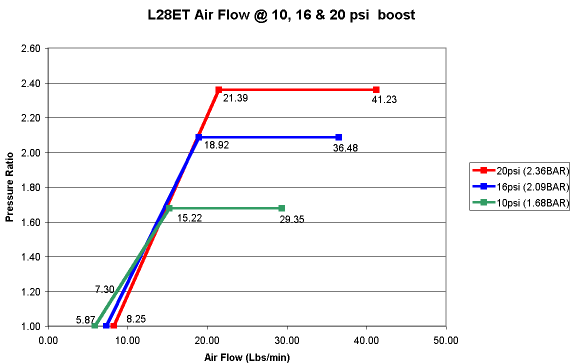
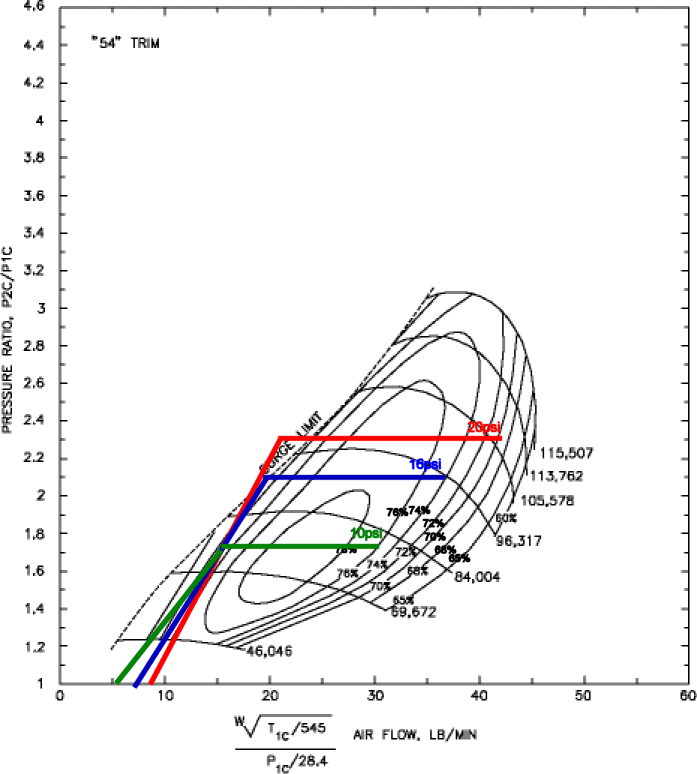
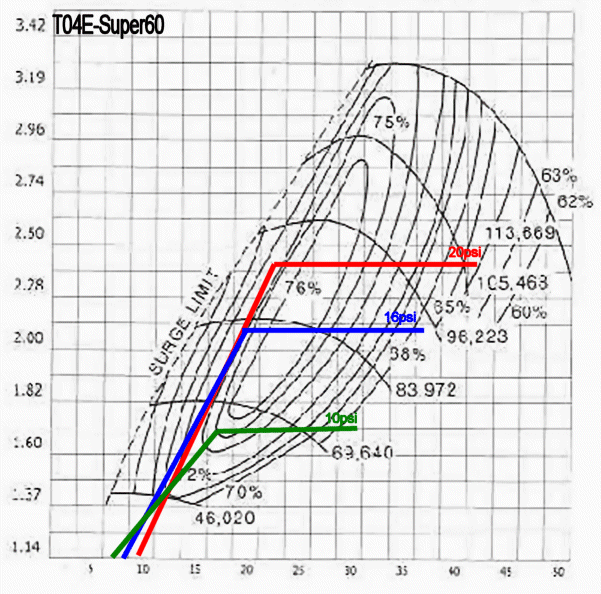
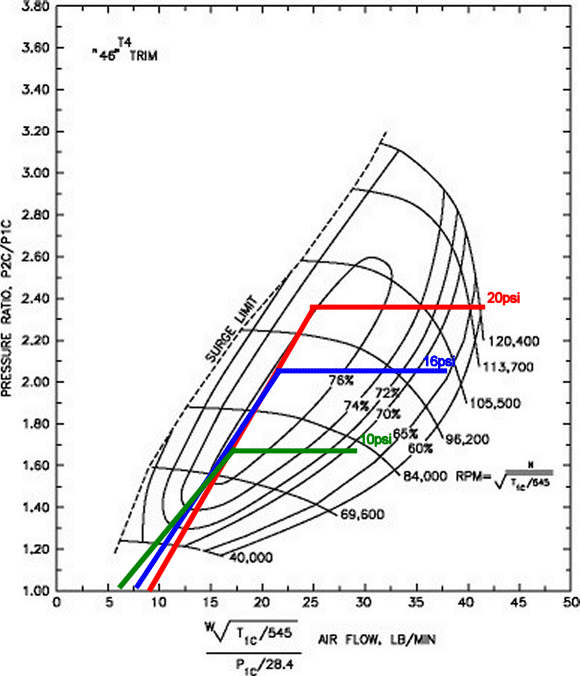
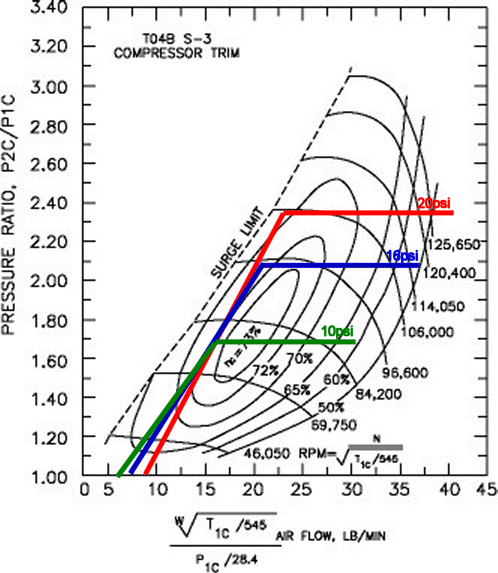
Each boost level is drawn as a line with three points:
- Start (left): 20% of redline (about 1,300 rpm), before the turbo makes boost (pressure ratio 1).
- Knee: full boost arriving at half of redline (3,250 rpm). Where full boost really comes in depends on the turbine housing’s A/R, so this point is a reasonable guess, not a fixed number.
- End (right): full boost at the 6,500 rpm redline.
On a compressor map, the oval “islands” show efficiency, highest in the middle. You want the knee and the redline point both inside good islands, and the knee comfortably to the right of the surge limit (the dashed line on the left). Past the surge line the compressor can’t hold the pressure and the airflow stalls and reverses. Low efficiency at redline means hot intake air, which costs power and invites detonation.
Summary
| Compressor | Verdict for an L28ET |
|---|---|
| Garrett T3-60 (stock) | Too small, runs hot at redline |
| Garrett T04E-50 trim | Just right |
| Garrett T04E-57 trim | OK, but not the most efficient |
| Garrett T04E-54 trim | OK, but needs a dual-stage boost controller |
| Garrett T04E Super 60 | OK, but not the most efficient |
| Garrett T4-46 trim | Not much better than stock |
| Garrett T04B S-3 trim | Not much better than stock |
| Garrett T61 | Too big |
| Garrett T04B 60-1 trim | Too big for a stock-size engine |
| Garrett GT35R | Good for a turbo stroker |
The Maps
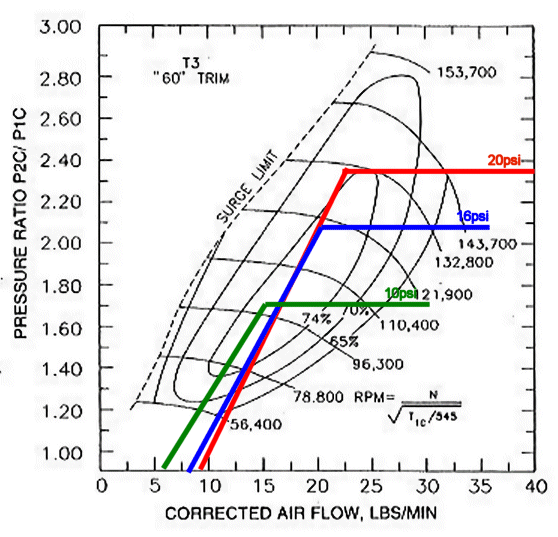
Garrett T3-60 (stock): Too small, runs hot at redline
The 3,250 rpm knee sits in the 74% sweet spot, so it pulls well from about 3,250 to 4,500 rpm. At redline it drops to 60% or less, and it gets worse toward 20 psi, so the air comes out hot. It’s sized for low boost on a smaller engine.
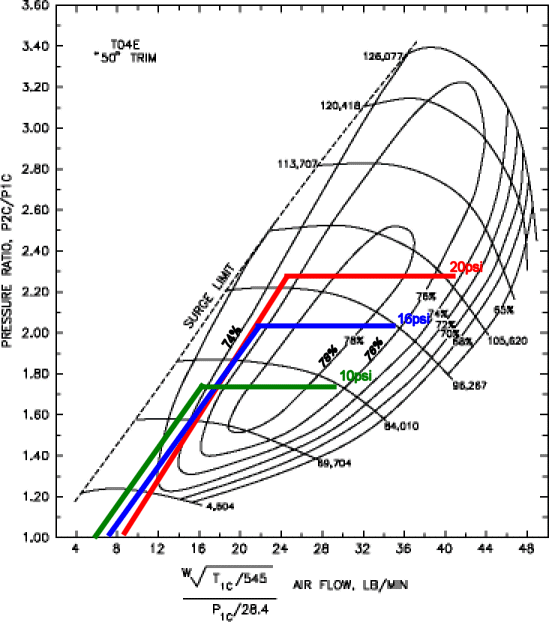
Garrett T04E-50 trim: Just right
Redline lands at about 75% and the knee at about 74%, and efficiency peaks near 78% in between. It stays efficient across the whole range at all three boost levels and leaves room to grow.
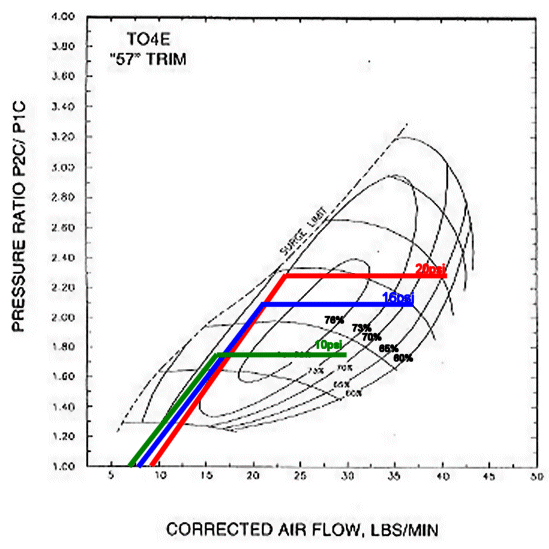
Garrett T04E-57 trim: OK, but not the most efficient
The knee is at 73% and it peaks around 76% on the way to redline, then falls to 65–72% at redline.
Garrett T04E-54 trim: OK, but needs a dual-stage boost controller
Redline is a good 70–76%, but two of the 3,250 rpm knees fall past the surge limit. To run high boost you’d need a dual-stage boost controller that only allows it at higher rpm.
Garrett T04E Super 60: OK, but not the most efficient
The knee is a strong 77%, but redline drops to 65–68%. Fine at 16–20 psi; only just OK at 10 psi.
Garrett T4-46 trim: Not much better than stock
The knee is 76%, but efficiency falls off to 60–75% at redline (less than the stock T3-60 does). Best at 8–12 psi on a lower-flowing engine.
Garrett T04B S-3 trim: Not much better than stock
The knee is 69–72% and it peaks at 73%, but redline drops to 45–60%. Best at 8–12 psi on a lower-flowing engine.
Garrett T61: Too big
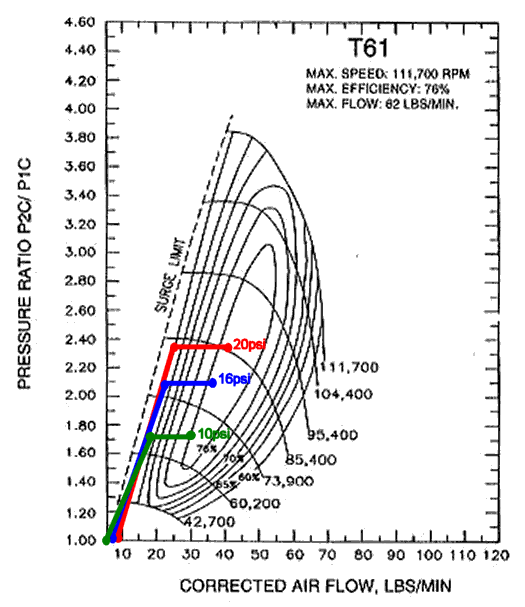
Redline sits in the 76% sweet spot, but the knees are about 66% and right at the surge limit. It only works well near redline, which suits a drag car more than the street.
Garrett T04B 60-1 trim: Too big for a stock-size engine
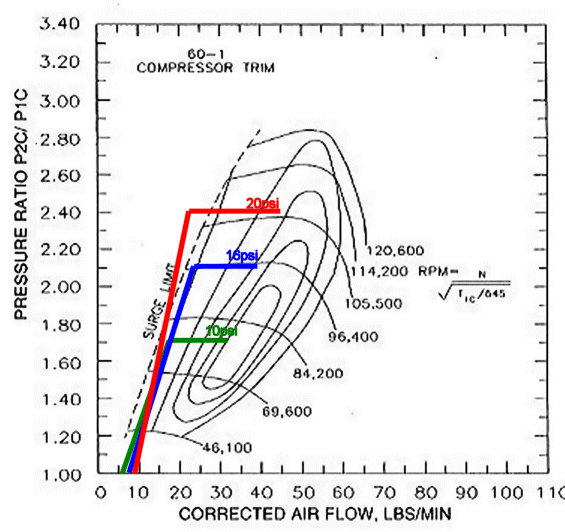
Its most efficient area is far to the right, at more airflow than an L28 makes, and the knees fall in the surge area. It’s meant for a larger engine.
Garrett GT35R: Good for a turbo stroker
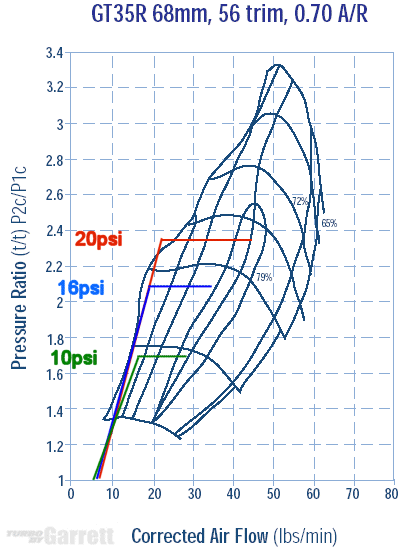
Redline is 72–79% and still climbing, but the knee is below 65%. It works best flat out and would suit a larger-displacement engine, such as a stroked L-series.
Related
- The Great L28 Turbo Guide: Converting a Non-Turbo L28 to Turbo
- Megasquirt and Microsquirt Standalone EFI
Credits
- Airflow calculations and compressor map plots from the Atlantic Z Car Club tech tip “L28ET Engine Air Flow and Turbo Compressor Maps.” Rewritten for XenonZcar.
- Compressor maps are Garrett’s.