
Z32 Fuel Injector Problems: Broken Pigtails and Failed Injectors
A Z32 that suddenly starts to lope, shake at idle and lose power is very often running on five cylinders, and the cause is usually one of two things: a broken or corroded injector connector (pigtail), or an injector that has failed inside. Both are common on these cars, and early-style injectors on the twin turbo are the worst for it. The good news is that you can find the culprit with a multimeter before you pull anything apart.
- Injector resistance
- 10–14 Ω
- Fuel pressure
- 36.3 psi idle / 43.4 psi hose off
- Trouble codes
- 45 leak, 51 circuit
- Plenum pull
- A long weekend
Symptoms
- A sudden miss: rough, loping idle, shaking, and the engine sounds like it's “coughing”. Often it comes on all at once while driving.
- A miss that comes and goes, often worse when the engine is hot or over bumps. That points to a loose or cracked connector rather than a dead injector.
- Loss of power, hesitation under load and poor fuel economy.
- Check engine light with code 51 (injector circuit) or code 45 (injector leak) on 1990–95 cars, read from the ECU's red and green LEDs.
- A strong fuel smell or a wet, fuel-fouled spark plug: an injector leaking or stuck open. Don't keep driving a car that smells of raw fuel under the hood.
Why They Fail
Pigtails (connectors)
The six injector connectors live in the valley under the plenum, the hottest spot on the engine. After 30 years of heat cycles the plastic goes brittle and crumbles, the locking clips break, the wire insulation cracks right behind the plug, and the early style connectors, which aren't sealed, let in moisture that corrodes the pins. Many of them break the moment you try to unplug them. Nissan changed to a more heat-resistant connector for 1995.
Injectors
The usual failure is inside the injector: the thin leads to the solenoid coil corrode until their resistance climbs out of spec, or they break open, and the injector stops firing. Many owners blame modern ethanol-blended fuel for speeding this up on the early injectors. Injectors can also clog, so they fire but deliver too little fuel, or stick and drip fuel into the cylinder.
Each bank of three cylinders shares one oxygen sensor. When one injector is weak, the ECU sees a lean bank and adds fuel to all three cylinders, so the other two run rich. A weak injector can hide for a long time before it shows up as a miss.
Early vs Late Injectors
Know which style you have before you order parts. The insulators, O-rings, connectors and even the plenum gasket are different.
| Early style | Late style | |
|---|---|---|
| Used on | 1990–92 non-turbo, 1993 convertible, 1990–94 twin turbo | 1993–96 non-turbo coupe, 1995–96 twin turbo |
| Connector | Square, held by a separate wire spring clip | Oval, with a built-in squeeze latch |
| Tip | Pintle | Pintle-less |
| Failure rate | High: the coil leads corrode | Much lower |
Late-style injectors can go into an early fuel rail with an adapter kit, and many owners do this when they replace a set. If you fit larger aftermarket injectors, the ECU needs a matching chip or tune to suit them.
Finding the Dead Cylinder
- Read the codes from the ECU (behind the passenger kick panel). Code 51 sends you straight to the injector wiring; code 45 to a leaking injector.
- Find the cylinder. With the engine idling, unplug the coil packs one at a time. When you unplug a good cylinder the idle drops further; unplug the dead one and nothing changes.
- Rule out ignition. Swap the spark plug and coil pack from the dead cylinder with a good one. If the miss stays on the same cylinder, it's fuel, not spark.
- Test the injector and its wiring with the three tests below, in order.
Ohm Test
This finds most dead injectors and you don't need to remove anything but the plenum's top cover. You'll need a multimeter, dental picks or small pliers for the connector clips, and electrical contact cleaner.
- Remove the cover on top of the plenum (the one with the NISSAN logo). The six connectors sit along the injector rails, three per side.
- Unplug each connector. On early injectors pry off the small wire spring clip first, gently, because the old plastic breaks easily.
- Clean the pins on the injector and in the connector. Corroded pins give false readings and, on their own, are often the whole reason a cylinder is dead.
- Set the meter to its lowest ohms range above 14 (usually 20 Ω), touch the probes together to see how much the leads read, and subtract that from your readings.
- Measure across the two injector pins. A good injector reads 10–14 Ω (Nissan's spec). High readings are the common failure; an open circuit (the meter shows 1, OL or ∞) means the coil is broken. Either way, replace the injector.
- Plug the connectors back in and make sure each one is locked. A connector that won't stay on is the next fault waiting to happen.
Click Test
An injector can pass the ohm test and still be stuck or clogged. You can hear each one fire by turning the crank angle sensor (CAS) by hand, which makes the ECU think the engine is turning.
Disable the fuel pump first (pull the fuel pump relay or unplug the pump) and release the fuel pressure. If the pump runs during this test the injectors flood the cylinders, and a cylinder full of fuel can hydrolock and bend a rod when the engine is next cranked.
- Mark the CAS's position on its mount with paint or a scribe. It must go back exactly where it was, or the ignition timing will be off.
- Remove the CAS mounting bolts and pull the sensor out, leaving it plugged in.
- Turn the ignition on (don't crank it).
- Slowly turn the CAS shaft by hand (counter-clockwise looking at the end of the shaft) and listen. Each injector should click in turn, and all six should sound alike.
- An injector that doesn't click, or sounds different from the rest, is stuck, clogged or not getting a signal. Check its wiring before you condemn it.
- Refit the CAS to your marks, reconnect the fuel pump, and check the timing if you have any doubt.
Testing Through the Harness
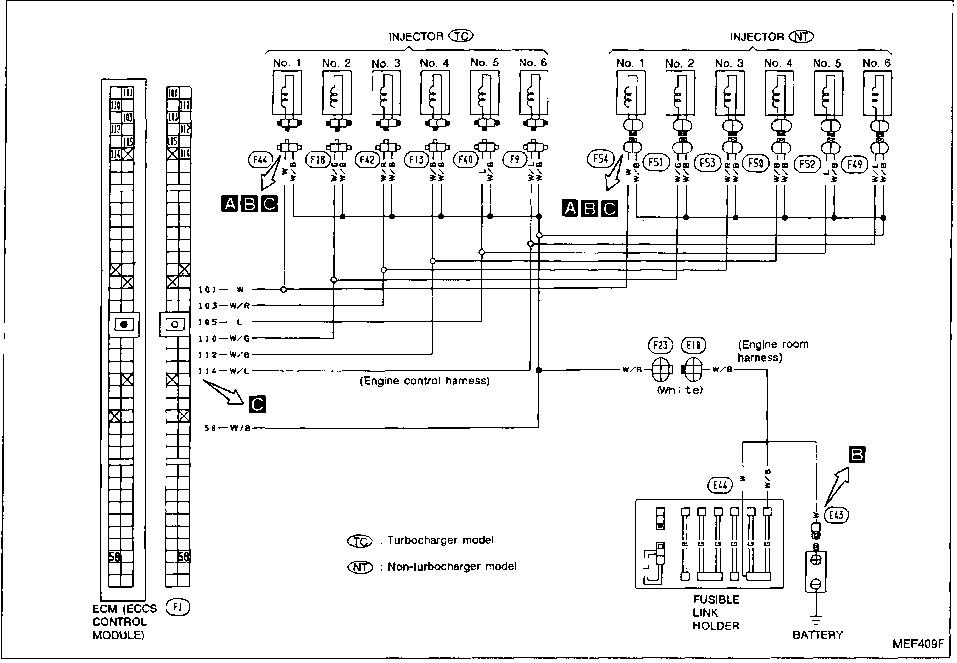
If an injector reads good on its own pins but won't click, the fault is between it and the ECU. The ECU switches each injector to ground; all six share one power feed.
- Disconnect the battery. Remove the passenger kick panel and unplug the ECU (one 10 mm bolt holds the connector).
- Measure from ECU harness pin 58 (injector power) to each injector's ground pin. Each should read 10–14 Ω, just like at the injector. Small paper clips help you reach into the connector.
- If one reads open, unplug that injector and bridge the two pins in its harness connector with a paper clip, then measure again from the ECU end. You should now see close to 0 Ω. If it's still open, the break is in the harness or pigtail.
| Injector | 1 | 2 | 3 | 4 | 5 | 6 |
|---|---|---|---|---|---|---|
| ECU pin | 101 | 110 | 103 | 112 | 105 | 114 |
Fixing Broken Pigtails
New connector pigtails are cheap and sold for both the early square and late oval styles. Order the style that matches your injectors.
- Cut the old connector off, leaving as much of the harness wire as you can. Stagger the cuts so the two joints don't sit side by side.
- Strip back past any cracked or stiff insulation. If the copper is green or the insulation crumbles further back, keep cutting until you reach good wire.
- Solder each wire to the new pigtail and seal the joints with heat-shrink tubing (adhesive-lined is best). Crimp butt connectors tend to fail in this heat.
- Wrap the harness and secure it away from hot metal.
If several connectors are cracked, the rest aren't far behind. Do all six at once, or replace the injector sub-harness. Nissan sold injector harnesses with the late-style connectors; twinturbo.net lists 24079-25P26 (two per car, one per bank).
Replacing Injectors
The injectors sit under the intake plenum, so replacing one means a plenum pull: drain the coolant, release the fuel pressure, remove the plenum, and lift out the fuel rails with the injectors attached. While it's off, it's the time to do everything else under there.
- Replace all six injectors, not just the dead one. They're the same age, and one weak injector makes its bank run badly.
- Use new O-rings and insulators on every injector, lightly oiled. A pinched O-ring leaks fuel, so seat each injector carefully and never force it.
- Replace the rubber fuel hoses under the plenum, including the hose that joins the two rail halves. Old hoses crack, and a fuel leak onto a hot engine is a fire.
- Replace the coolant hoses under the plenum while you can reach them, along with the plenum gasket.
- Fix the connectors while they're in reach (above).
- Check for leaks before the plenum goes back on: turn the key to run the fuel pump and look at every injector and hose joint. Nissan's manual calls for this too.
Fuel safety: release the fuel pressure before opening any fuel line. The factory way is to pull the fuel pump relay, start the engine, let it stall, then crank it a couple more times. Work with the battery disconnected, have a fire extinguisher close, and plug the intake ports so nothing drops into the engine.
Sources Used
- Nissan 1994 300ZX service manual, EF & EC section: injector resistance, fuel pressure, codes 45 and 51, the injector circuit and ECU pins, and injector removal. Read the EC section
- Ohm, click and harness tests adapted from the Injector Testing page of the Concept Z Performance wiki.
- Injector styles and plenum-pull parts from the twinturbo.net plenum and injector guide.
- A real-world dead-cylinder diagnosis: Peter Monshizadeh, “Fuel Injector Failure Is Just Another Day Of Nissan 300ZX Twin Turbo Ownership”, Jalopnik, 2017.