



S30 Hub Differences
From the outside the 240Z, 260Z and 280Z hubs look alike, and many parts swap between them. But Nissan made the front hubs and rotors stronger when the 260Z arrived, and later cars got stronger rear stub axles. Mixing early and late parts is one of the most common reasons a rotor rubs or a companion flange won't fit.
Note: Most of what is known about these changes comes from owners comparing parts, not from Nissan. Sources disagree on exactly when each change happened, and many cars have had parts swapped over the years. Always check the parts on your car before you order.
At a Glance
| Part | 240Z (1970–73) | 260Z / 280Z (1974–78) | Swaps? |
|---|---|---|---|
| Front hub | Scalloped between the studs, thinner flange | Round, thicker casting and flange, different offset | Only with the matching rotor |
| Front rotor | Shorter "hat" (about 1.5") | Taller hat (about 1.7" / 43.5mm) | Keep each rotor with its own hub |
| Front caliper | Same caliper on both | Same caliper on both | Yes |
| Rear stub axle | 25 splines | 27 splines on later cars (280Z and some late 260Zs) | Only with the matching companion flange |
| Front wheel bearings | Inner and outer tapered rollers | Same bearings | Yes, same parts 1970–83 |
| Bolt pattern | 4 x 114.3mm (4 x 4.5") | 4 x 114.3mm (4 x 4.5") | Yes |
Front Hubs
The front hub carries the wheel studs, and the brake rotor bolts to its back side. Two versions were used:
- 240Z: the outer edge of the hub is scalloped, with material cut away between the wheel studs, so it looks squared-off.
- 260Z and 280Z: the hub is round with no scallops, a thicker casting and a wheel-mounting flange about 1mm thicker. Owners believe it was strengthened for the heavier 2+2.
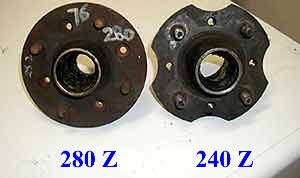
The later hub also places the rotor about 5mm differently, because Nissan changed the rotor offset at the same time (see below). So a hub and its rotor work as a pair.
The change is usually given as the start of the 260Z (around an August 1973 build date), but some parts catalogs list the 1974 260Z with 240Z parts. Look at the hub edge to be sure: scalloped means early, round means late.
Front Rotors
All S30s use solid front rotors with the same caliper, but the rotor's hat height (how far the braking surface sits from the face that bolts to the hub) changed with the hub. The 260Z/280Z rotor has a hat of about 43.5mm (1.7"), and the 240Z rotor is about 1.5". Owners report that the change let Nissan tighten the rotor runout spec.
- Late rotor on an early hub: the back of the rotor can rub the dust shield, and the caliper won't line up with the rotor.
- Early rotor on a late hub: the same problem in reverse.
- The fix: swap the hub and rotor together. A 240Z can use 260Z/280Z hubs and rotors as a set.
Aftermarket catalogs don't agree on which years get which rotor, so measure the hat height of the old rotor before you order. Some big-brake kits also specify the later hub.
Rear Stub Axles and Companion Flanges
At the rear, the wheel bolts to the rear axle shaft (usually called the stub axle). It turns in two ball bearings in the bearing housing at the bottom of the strut. On the inner end, a companion flange slides onto its splines, and the half shaft bolts to that flange.
- 240Z and early 260Z: 25 splines.
- 280Z and later 260Z: 27 splines, and owners report a larger diameter at the base of the threads. Some later stub axles have four raised bumps on the wheel flange; early ones are flat, but owners have found exceptions, so count the splines.
The stub axle and companion flange must match: a 25-spline flange won't go on a 27-spline axle. The 280Z stub axle is generally considered the stronger one, and 240Z owners often swap them in. It fits the 240Z bearing housing, but you need the matching 27-spline companion flanges too. Some owners report that the half-shaft side of the flange is the same, so the half shafts carry over.
The 280ZX stub axle is different again: its bearing seat is smaller, so it doesn't take S30 bearings directly.
Wheel Bearings
- Front: inner and outer tapered roller bearings on the spindle, with a grease seal on the inner side. Parts suppliers list the same bearings and seals for every 1970–83 240Z, 260Z, 280Z and 280ZX.
- Rear: two ball bearings in the bearing housing, with a distance piece between them. The outer bearing is sealed on one side, and that side faces the wheel. Most owners replace the bearings whenever the stub axle comes out, as the factory manual says not to reuse them.
- Wheel studs: front studs are shorter than rear studs (about 1.47" overall at the front).
Service Specs
From the 1975 280Z factory service manual (FA and RA sections). Check your own year's manual on the S30 Factory Service Manuals page.
Front wheel bearing adjustment
- Tighten the wheel bearing lock nut to 18–22 ft-lb (2.5–3.0 kg-m).
- Turn the hub a few times both ways to seat the bearings, then tighten to the same torque again.
- Back the nut off 60°, fit the adjusting cap and line up a slot with the hole in the spindle. If it won't line up, back off up to 15° more.
- Check the preload with a spring scale on a wheel stud: 1.5–3.3 lb with new parts, or 0.4–1.8 lb with used parts. There must be no play at all.
- Fit a new cotter pin through the cap and spindle.
Rear wheel bearings
- Rear wheel bearing lock nut: 181–239 ft-lb (25–33 kg-m).
- The bearing housing is stamped A, B or C. Use a distance piece with the same letter.
- Replace the grease seal every time the axle is taken apart.
Sources Used
- 1975 Datsun 280Z Factory Service Manual, sections FA and RA
- HybridZ: 240Z/260Z front hub difference
- Classic Z Car Club: 280Z hub vs 240Z hub
- HybridZ: 240Z front brake rotor differences from 260 and 280
- Classic Z Car Club: Stub axle differences 240Z, 260Z and 280Z
- HybridZ: 240Z stub axle versus 280Z stub axle
- Z Car Depot and The Z Store bearing and stud listings