
Z32 Twin Turbo System
The Z32 Twin Turbo's VG30DETT uses two small turbochargers in parallel, one on each bank of the V6. Each turbo is fed by its own bank's three exhaust ports and sends its air through its own charge air cooler, and the two streams meet at the throttle bodies. Small turbos spool quickly, which is why the Z32 TT makes its 283 lb·ft of torque as low as 3,600 rpm.
- Layout
- Parallel twin, one turbo per bank
- Turbos
- Garrett, water and oil cooled
- Stock boost
- About 9–10 psi
- Intercoolers
- Two, in the front bumper corners
How It Works
- Turbochargers: Garrett units, mounted low on the exhaust manifolds deep in the engine bay. They're oil-lubricated and water-cooled, with lines from the engine's oil and coolant systems.
- Charge air coolers: one per turbo, mounted in the corners of the front bumper. Pressurized air goes from each turbo forward to its cooler and back to the intake.
- Wastegates: each turbo has an internal wastegate opened by a pressure actuator. The 1994 manual tests the actuator at 78–88 kPa (11–13 psi) of air pressure, briefly, and checks that the rod moves smoothly.
- Boost control: the ECU runs wastegate control solenoid valves. When the engine is running, the throttle is open (throttle sensor above 0.1 V) and the knock sensor hears no knock, the solenoids switch on for the higher boost setting. If the ECU detects knock, which it takes as low-octane fuel, it switches them off and boost drops to the lower level.
Use premium fuel. The ECU only allows full boost when it hears no knock. On lower octane fuel the car runs on reduced boost and feels flat.
Factory Inspection Specs
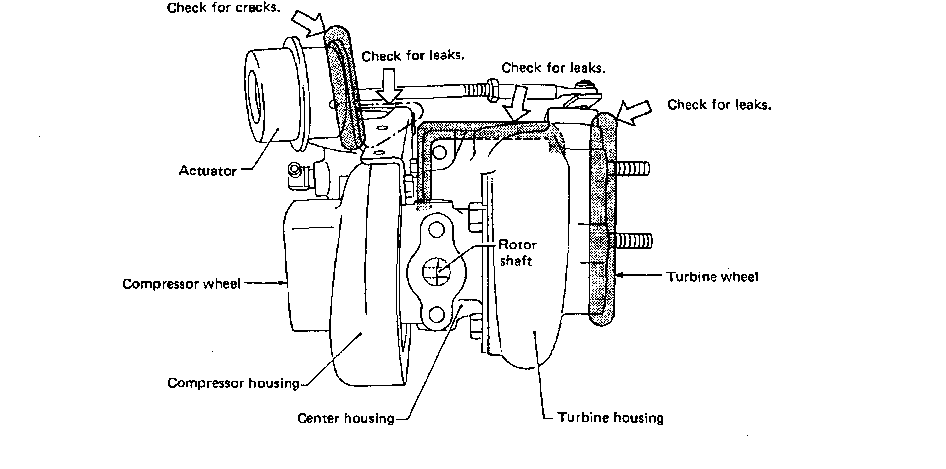
- Rotor shaft: must turn smoothly by hand, with no carbon at the oil return hole. Runout 0.056–0.127 mm (0.0022–0.0050 in); end play 0.013–0.096 mm (0.0005–0.0038 in).
- Turbine wheel: no oil, carbon, bent fins, or rubbing on the housing.
- Compressor wheel: no oil, bent fins, or rubbing on the housing.
- Wastegate valve: no cracks, moves freely, and the seat is smooth.
- Oil and water tubes: clear, not clogged. Clogged oil feed lines starve and kill the turbo bearings.
Common Problems
- Blue smoke, especially on startup or after idling, and oil in the intercooler piping point to worn turbo seals. Rule out the PCV system first: crankcase pressure pushes oil past good seals too.
- Low or uneven boost usually comes from boost leaks in the intercooler hoses and couplers, cracked vacuum lines to the wastegate actuators and solenoids, or a sticking wastegate.
- Boost too high (or a fuel cut) can mean a stuck-shut wastegate or a disconnected boost control hose.
- Old rubber: the turbos sit in the hottest part of the bay, and their coolant and oil lines, vacuum hoses and couplers all harden with age. Replace them when the turbos come out.
Replacing the Turbos
Nissan's manual removes each turbo in the car, together with its exhaust manifold, but it's a long job with very little room. Many owners pull the engine instead, and use the chance to renew everything else in reach: the timing belt, water pump, hoses, injectors and seals.
Taking Care of Them
- Change the oil on time with a good-quality oil. Nissan recommends 10W-30 and says to use 5W-30 on the twin turbo only in extreme cold. See fluids.
- Let the engine warm up before using boost.
- After hard driving, idle for a minute before switching off so the turbos can cool down while oil is still flowing.
- Raising boost on the stock turbos increases heat and wear. Add fuel and engine management to match, and watch the knock sensor.
Sources Used
- Nissan 1994 300ZX service manual: EM section (turbochargers, charge air coolers, inspection specs) and EC section (wastegate valve control). Read the EM section
- Stock boost estimates from owners on the NICOclub forums and Drifted.