
280ZX Turbo Basics: L28ET Turbo, Boost and Fuel
The 1981–83 280ZX Turbo’s L28ET is a mild, reliable turbo engine from the factory, and there’s a lot of room left in it. Before turning up the boost, it helps to know how the system works and what holds it back. This page covers the stock setup, the limits of the stock parts and the usual upgrades.
The Stock Setup
| Turbo | Garrett AiResearch T3, 60 trim compressor, .63 A/R turbine |
|---|---|
| Normal boost | About 6 psi, full boost around 3,000 rpm |
| Wastegate opens (FSM, 1982) | 41.9–47.2 kPa (6.1–6.8 psi) |
| Relief valve opens (FSM, 1982) | 50.7–53.3 kPa (7.4–7.7 psi) |
| Compression | 7.4:1 (F54 block, dished pistons, P90 head). The non-turbo L28s run about 8.3–8.8:1. |
| Injectors | 265 cc/min (25.2 lb/hr); the non-turbo 280Z uses 185 cc/min (17.6 lb/hr) |
| Intercooler | None |
The 1982–83 F54 block is the same for turbo and non-turbo engines; the main difference is the pistons (dished for the turbo, flat-top for the non-turbo). A thicker 1 mm head gasket lowers compression to about 7.5:1.
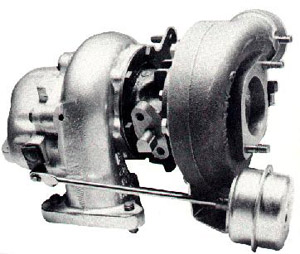
The T3
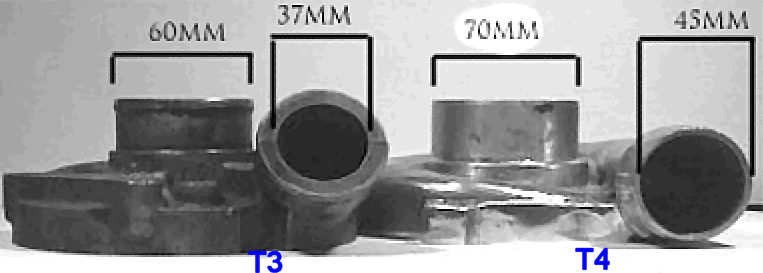
Garrett built the T3 for medium-size engines in the 175–250 hp range and made millions of them. It’s rated to about 15 psi.
| Weight | 5.3 kg | Bearing span | 31.9 mm |
|---|---|---|---|
| Compressor wheel | 51.4 mm | Turbine wheel | 53 mm |
| Oil flow | 1.2 L/min (SAE 30 at 90 °C and 2.75 bar) | ||
Fuel
More air needs more fuel. You can add fuel with bigger injectors or higher fuel pressure; bigger injectors are the usual route, and the airflow meter and ECU then have to be recalibrated to match.
The stock injectors start to run lean at about 10 psi at normal fuel pressure. At that boost the engine moves roughly 1,761 lb of air an hour; at a 12:1 air-fuel ratio that’s about 147 lb/hr of fuel, or 24.5 lb/hr per injector, right at the stock injector’s limit. Owners generally put the stock injectors and ECU good for about 270 crank hp.
Rough injector sizes for a turbo six:
| Engine hp | Rear-wheel hp | cc/min | lb/hr |
|---|---|---|---|
| 200 | 160 | 268 | 26 |
| 250 | 200 | 335 | 32 |
| 300 | 240 | 402 | 38 |
| 350 | 280 | 468 | 45 |
| 400 | 320 | 535 | 51 |
How Much Boost?
- Stock: about 6 psi.
- Safe without an intercooler: about 10 psi, and be careful above 8 psi.
- The T3’s limit: about 15 psi, but by 6,000 rpm its efficiency has dropped to around 60%, so the air coming out is hot. See L28ET Airflow and Turbo Compressor Maps.
How the System Works
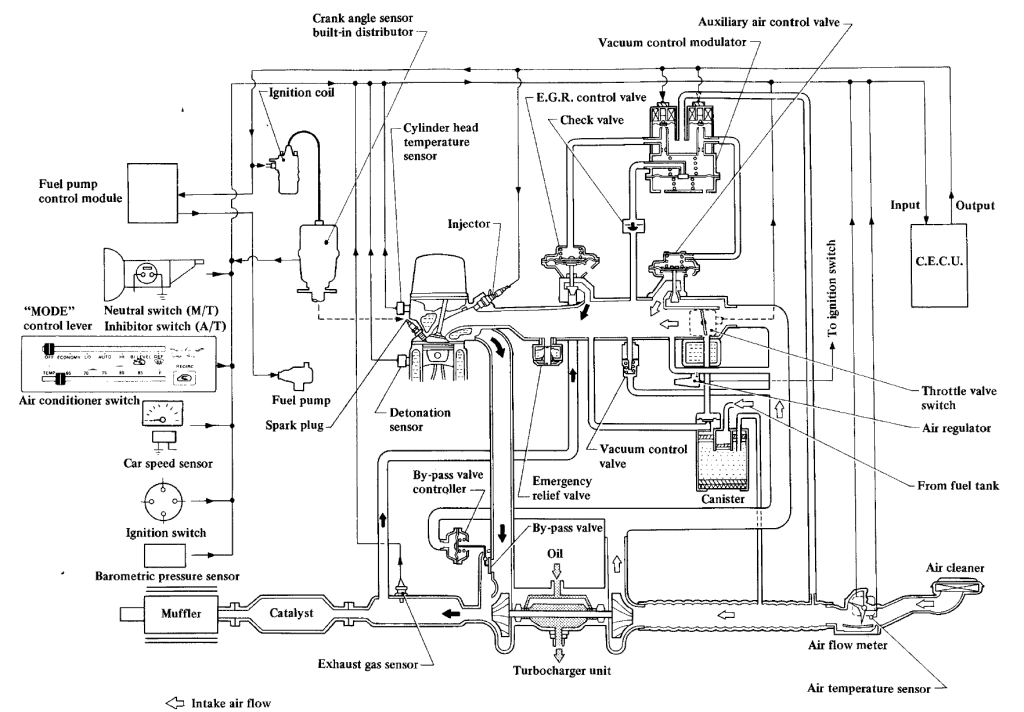
- Exhaust spins the turbine, which drives the compressor on the same shaft.
- The compressor draws air in through the air cleaner and the airflow meter. The ECU meters fuel from the airflow meter’s reading.
- The compressor squeezes the air, which also heats it.
- On a modified car, the intercooler cools the charge before it goes through the throttle and intake manifold.
- Fuel is injected, compressed and fired, and the exhaust goes back out through the turbine.
Wastegate, Boost Controllers and Valves
Wastegate
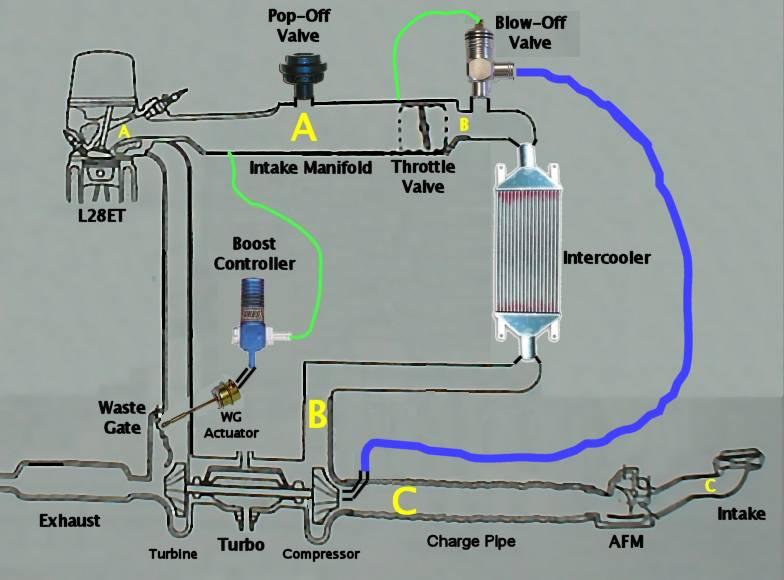
The wastegate lets exhaust bypass the turbine to cap boost. The stock one is held shut by a spring of about 7 psi in the actuator, and a diaphragm sensing manifold pressure opens it. For more boost you need a stiffer spring or a boost controller. With high pressure in the exhaust ahead of the turbine, the stock actuator can also creep open early.
Boost controllers
- Manual controllers bleed or hold back the signal to the wastegate actuator. Mount it under the hood with short lines.
- Electronic controllers use a solenoid valve, hold the wastegate shut more reliably, and can run two stages (for example, lower boost for launching and more in the higher gears).
- Take the controller’s signal from the intake manifold, not the compressor outlet, or it can overboost.
- Make adjustments in small steps and watch an accurate boost gauge.
Pop-off (relief) valve
The relief valve screwed into the back of the intake manifold is a safety valve: it vents if boost climbs past the limit, such as when a wastegate sticks. It’s usually set 2–4 psi above maximum boost (about 9 psi on a stock car, about 14 psi on an intercooled car running 12 psi). If you raise boost you have to raise its setting too; owners shim it with washers. Without it, a failed wastegate could let boost climb past 25 psi.
Blow-off and bypass valves
When you lift off the throttle under boost, the compressed air has nowhere to go and pushes back on the compressor. A blow-off or bypass valve opens on throttle lift and dumps that air. Set it by ear: it should vent on medium-to-high boost throttle lifts. Opening too early adds lag; too late and it doesn’t protect the turbo.
Intercoolers
The 280ZX Turbo has no intercooler, which is the main reason it’s limited to about 10 psi. Cooling the charge makes it denser and less prone to detonation; at street boost that’s worth about 10–20% more power.
- Efficiency is the temperature it removes divided by the temperature the turbo added. If the turbo adds 150 °F and the intercooler takes out 110 °F, it’s 73% efficient.
- Pressure drop should be under about 1–1.5 psi. Over 4 psi means the core is too small for the airflow. Drop rises with the square of the flow, so 50% more airflow means 2.25 times the drop.
- Keep the pipes short to cut pressure loss and lag.
- A used factory intercooler from another turbo car is a common budget choice; check its size and flow.
Twin Turbos
People have put twin turbos on the L28 and L26. Twins don’t make more power on their own. The usual reason is a sequential setup, where a small turbo spools first and a bigger one takes over at higher rpm to cut lag. Most of the strongest turbo cars run one well-matched turbo.
Upgrades and Owner Results
- T3/T4 hybrid: a T3 turbine with a T4 compressor is the classic L28ET upgrade. One owner’s hybrid made 150 lb-ft at 1,600 rpm and 310 lb-ft at 3,000 rpm, with a broad curve to about 5,500 rpm.
- T04E 50 trim: a T04E 50 trim compressor with a stage 5 turbine is quoted as good for about 500 hp, and will run on the stock wastegate actuator at about 7–8 psi. See the compressor maps, where the T04E-50 is the best match for the L28ET.
- Z31 300ZX T3: it fits, and its water-cooled center section is better for higher boost (the Merkur XR4Ti’s is another option).
- Z31 ECU and airflow meter: one owner ran 12 psi on a hot day and 14 on a cool day on stock injectors. Another made 253 rwhp (about 290 crank hp) at 11.8:1 with a Z31 ECU, a 60-1 turbo and 44 psi fuel pressure. See the EFI Upgrade Guide.
- Exhaust: a 2.5 in. downpipe with a boost controller brought full boost in at 2,700–2,800 rpm.
- Owner limits: one ran 10 psi for a year on a stock 1983 without an intercooler; another ran 12 psi intercooled on stock fuel; another lost a head gasket at 15 psi, even with an intercooler.
Parts Drawings
From the Nissan parts fiche. Tap any drawing to enlarge.
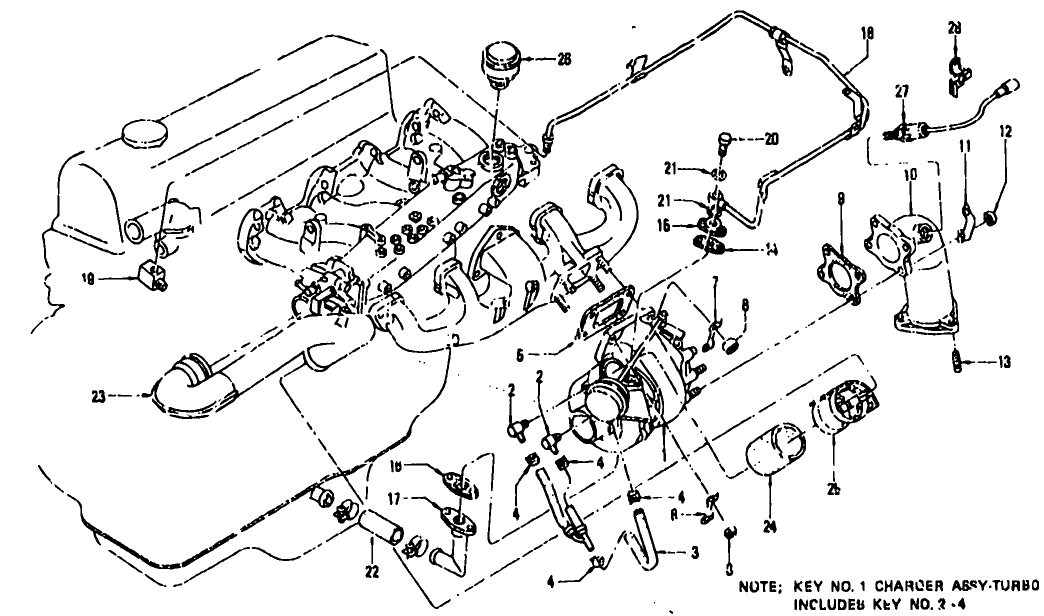
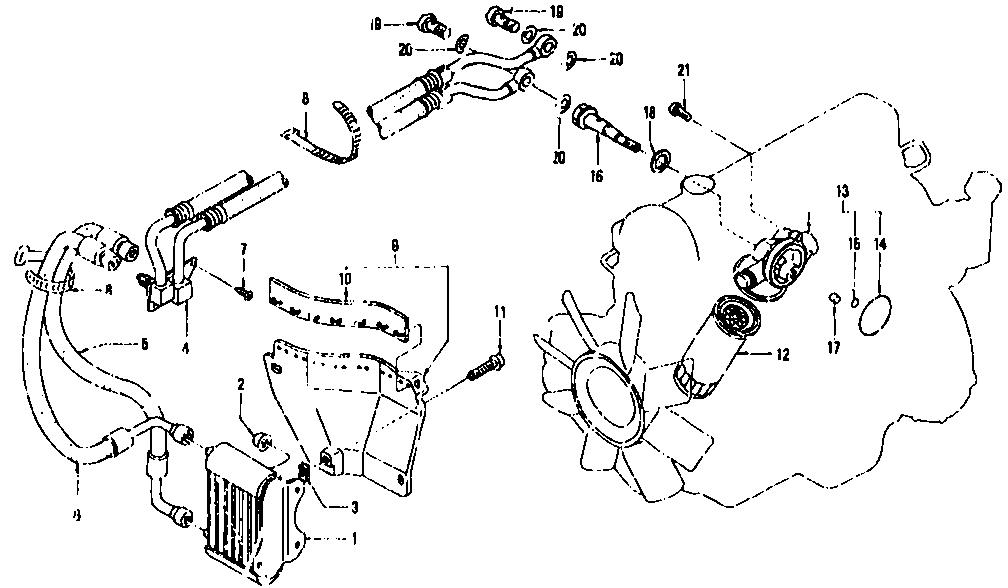
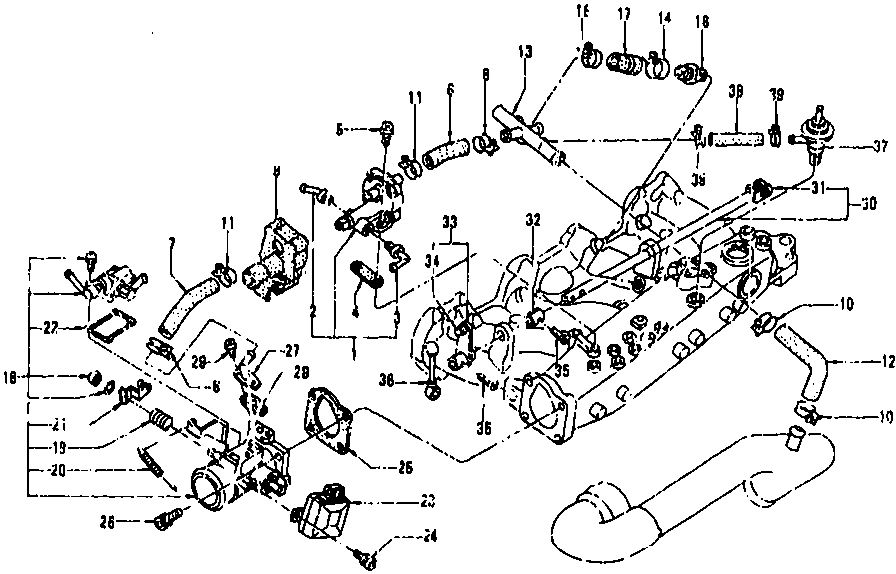
Look up part numbers in the S130 parts fiche.
Related
- L28ET Airflow and Turbo Compressor Maps
- The Great L28 Turbo Guide: Converting a Non-Turbo L28 to Turbo
- Megasquirt and Microsquirt Standalone EFI
Credits
- Compiled from the Atlantic Z Car Club Zcar Turbo Information page, which gathered posts from Zcar.com members (including ase mat on setting a blow-off valve). Rewritten for XenonZcar.
- System diagram and parts drawings: Nissan factory service manual and parts fiche.